


House sustainability technologies
- Irene Ludovic
- Sep 25, 2022
- 2 min read

Updated: May 29, 2023
Before starting to build a house, the role of this new building should be investigated. A new house should be much more than just a roof that keeps us dry and warm. It should address the current problems of society and therefore help us reduce our consumption of resources. Of course, not all problems can be addressed with a new house, but only those related to the household.
The three main sources of energy consumption at the individual level are:
housing, including the gray energy used to construct the building and the energy consumed by homes,
transport
and food production.
We believe that our future home can greatly reduce our environmental impact in these three areas.
Specifically, we plan that:
The building will store more carbon than it releases through its construction. We will achieve this by minimizing the use of concrete - concrete is responsible for half of the CO2 emissions in building construction. Using wood as a structural building element, clay for interior walls and floors, and cellulose for insulation.
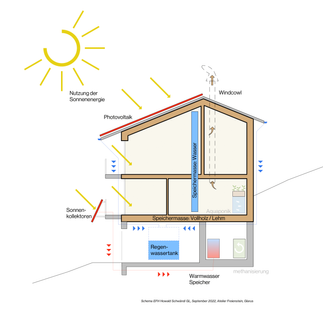
Large, south-facing windows protected by the roof and a balcony, so that in summer no direct sunlight enters the interior at noon, while in winter solar radiation is maximized to minimize the need for heating in winter, without the need for cooling in summer.
A very large specific heat (thermal mass) within the insulating envelope, consisting of clay walls and floors and large water columns. In a second phase, a swimming pool is planned in an outbuilding with the intention of further increasing this thermal mass.
18 m2 of thermal solar collectors together with a large water tank as a heat battery for domestic hot water and heating.
80 m2 of photovoltaic solar panels on the south side of the roof, providing electricity for domestic use and transport.
Rainwater tank for toilet water and aquaponic system.
Separating toilet to retain the valuable liquid fertilizer and reduce the load on the local wastewater treatment plant.
An anaerobic methanisation system to compost our green waste on site and produce methane. Our calculations show that the energy generation potential of such a facility is twice our anticipated demand. The methane will be stored, and in a second phase we will install a cogeneration system to generate heat and electricity when required.
An aquaponic system to produce fresh fruits, vegetables and fish. Several authors estimate that 6 m2 of aquaponic culture area per person provides enough fruits and vegetables for 5 servings per day.



Comments